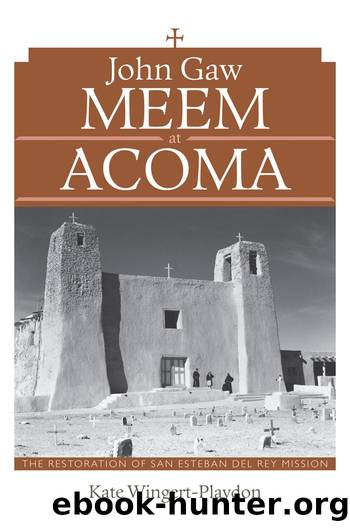
John Gaw Meem at Acoma by Wingert-Playdon Kate;
Author:Wingert-Playdon, Kate;
Language: eng
Format: epub
Publisher: University of New Mexico Press
The Structure Reveals More Information
With work about to restart, Reuter described where the job was on July 17. He had one tower ready to build and was waiting for John Meem to come and see them. He noted that, as the towers were similar, design decisions for both could be made by observing the one tower. On July 19 Reuter confirmed that the job was restarted. He had a crew that was working slowly but at least getting something accomplished. They started the week cleaning up around the towers, separating dirt that could be used for making adobe from white plaster that had covered the lower part of the front façade of the church. A pick was used to remove the plaster surface. Then the white plaster waste, which was not good material for the adobe mix, was picked up from the ground at the base of the tower, separated from the mud that would be reused to make mortar. The towers were found to have been covered with an adobe block veneer. Reuter reported that when they disassembled the tower, they found that the core was made of rock set in mud mortar. Many repairs from past maintenance cycles were discernible. Reuter also reported that the east façade of the church was in âdeplorableâ condition. Under the surface plaster they found a wall much in need of repair. Reuter stated that they had to remove what amounted to two tons of material with a pickax before they felt certain that they were rid of all of the rotten material. Unlike what they had found in other areas of the church, the adobes were not well made. In removing bad material they took out a piece of the wall from the church door to the tower that varied from about five to eight feet in height and extended about two feet in from the outer surface. As Reuter described the wall,
the seam reaches on up and is without doubt an ancient one but as the outer wall showed no rent, nothing could be gained in tearing it away any further. In fact if I proposed to follow up the rent I would have to make very extensive preparations to protect the wall before proceeding further.
Reuter speculated that the bad state of the wall could explain why the front façade, in particular the towers, had been remade at the turn of the century. He was not pleased to find the wall in such a state. He was once more looking at an unanticipated condition that would take time to fix. He told Meem it was a âdisappointmentâ that the work would âdevour considerable of [his] store of rockâ and they would have to gather more. Given the uncertain stability of the wall, he knew that its repair would take priority. Frustration is not uncommon when working with ancient structures, as Reuter noted in the July 19 letter: âYou can not know the extent of the reperition necessary in an old adobe building until you get through with the job.
Download
This site does not store any files on its server. We only index and link to content provided by other sites. Please contact the content providers to delete copyright contents if any and email us, we'll remove relevant links or contents immediately.
The Vikings: Conquering England, France, and Ireland by Wernick Robert(84576)
Ali Pasha, Lion of Ioannina by Eugenia Russell & Eugenia Russell(40380)
The Conquerors (The Winning of America Series Book 3) by Eckert Allan W(39021)
The Vikings: Discoverers of a New World by Wernick Robert(37048)
Cecilia; Or, Memoirs of an Heiress — Volume 1 by Fanny Burney(32717)
Cecilia; Or, Memoirs of an Heiress — Volume 2 by Fanny Burney(32083)
Cecilia; Or, Memoirs of an Heiress — Volume 3 by Fanny Burney(32063)
Empire of the Sikhs by Patwant Singh(23199)
The Secret History by Donna Tartt(19466)
Hans Sturm: A Soldier's Odyssey on the Eastern Front by Gordon Williamson(18723)
Cat's cradle by Kurt Vonnegut(15552)
Pimp by Iceberg Slim(14788)
Sapiens: A Brief History of Humankind by Yuval Noah Harari(14552)
Norse Mythology by Gaiman Neil(13564)
Talking to Strangers by Malcolm Gladwell(13535)
Leonardo da Vinci by Walter Isaacson(13505)
4 3 2 1: A Novel by Paul Auster(12609)
Underground: A Human History of the Worlds Beneath Our Feet by Will Hunt(12229)
The Radium Girls by Kate Moore(12177)
